
GuitarTotal
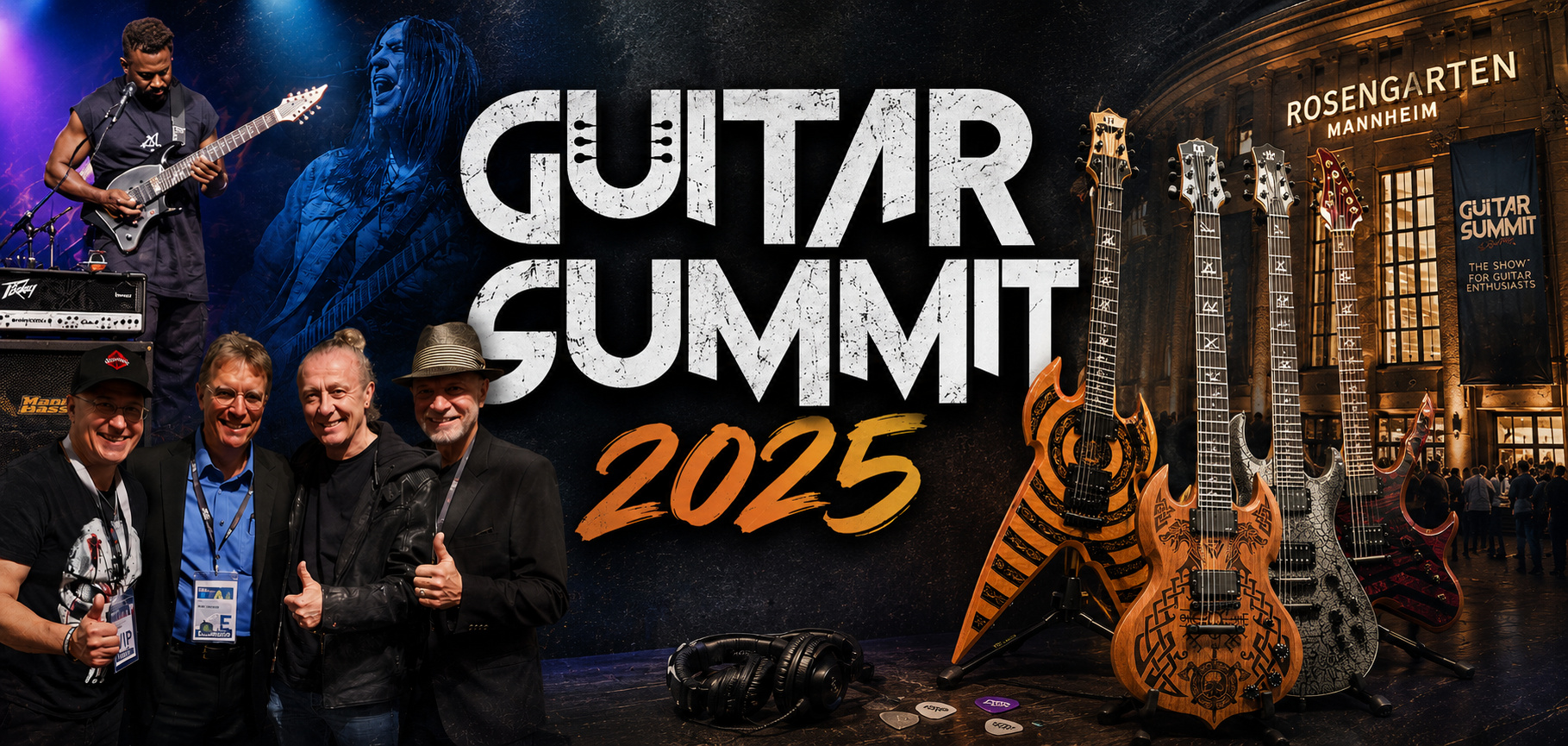
When guitarists, bassists, manufacturers, developers and music enthusiasts from all over Europe gather in Mannheim at the end of September, one thing is certain: the Guitar Summit has opened its doors again. Over the past few years, the event has firmly established itself as Europe's most important trade show for guitarists and bassists. Where classic music trade fairs used to dominate, the direct experience is now at the center: touching instruments, trying out amps, talking to developers and experiencing world-class musicians up close.
In 2025, too, the Guitar Summit once again offered everything to make a musician's heart beat faster. Spread across several halls, countless manufacturers presented their latest products – from boutique guitar builders to major traditional brands to innovative software and amp manufacturers. The program was rounded off by numerous workshops with top international musicians, live demonstrations and countless opportunities to network with like-minded people.
For me, however, the show played out a little differently than usual this year. While in previous years I tried to test as many guitars, amps and effects as possible, this time business matters took center stage at first. Talking with manufacturers, maintaining existing contacts and making new acquaintances – as a result, there was less time on Friday for extensive testing, but some encounters emerged that were at least as valuable as any new piece of gear.
The AMPX by Thomas Blug – the first product since the Kemper that genuinely excites me
One of my first stops took me to Thomas Blug. The exceptional guitarist has been one of the best-known German guitarists for many years and has built an excellent reputation not only as a musician but also as a developer of innovative products.
I was especially curious about his new amplifier, the AMPX. Since the Kemper, hardly any new amplifier concept has truly captivated me for long. Of course, new modelers and profilers appear regularly, but they are often more evolution than revolution. With the AMPX, however, I had the feeling from the very first moment that something genuinely exciting was taking shape.
Thomas explained the concept with great passion, without falling into typical marketing clichés. That's exactly what makes him so likeable. You immediately notice that this is a musician developing the product, someone who knows the demands of modern guitarists from his own experience. If everything goes according to plan, the AMPX will be finished by the end of the year and available in 2026. For me, it's already one of the most interesting products of the coming months.
Tosin Abasi – world-class technique, yet completely down to earth
One of the absolute highlights of the Guitar Summit for me was the workshop by Tosin Abasi. Anyone who knows Animals As Leaders knows why he is regarded today as one of the most innovative guitarists of our time. While you can recognize influences from John Petrucci, with his thumping technique, eight-string guitars and extraordinary sense of rhythm, Abasi has long since developed a completely distinctive style of his own.
Even more impressive than his virtuoso playing, however, was his personality. Even though he now develops and sells successful products of his own, the gear was never the focus during his workshop. Instead, he spoke openly about how material is often overrated, and how psychoacoustics play a far bigger role than many musicians believe when buying new equipment. I found this honesty remarkable. Someone who sells their own products could easily have turned this into a promotional event. Instead, his message was: focus on your playing. It's exactly this attitude that makes him not only an extraordinary musician but also an exceptionally likeable person. And, incidentally, he looks like he could enter a bodybuilding competition at any moment.
Conversations with genuine legends
Encounters like these are precisely what make the Guitar Summit so appealing to me. Between workshops, conversations keep arising with people who have shaped the guitar world for decades. I had the opportunity to talk for around fifteen minutes with Rob Turner, the founder of EMG Pickups.
Despite his legendary status, he was completely relaxed and without a trace of diva behavior. He took the time for a conversation, spoke openly about his work, and gave the impression of someone who has never lost his passion for music. The encounter with Hap Kuffner, the former Vice President of Steinberger, was very similar. Both impressed with their down-to-earth manner and authenticity – qualities that are especially appreciated in people of their stature.
Sandberg and Markbass – my endorsement partners side by side
Of course, a visit to my endorsement partners Sandberg and Markbass couldn't be missing either. While walking around, I had to smile, because both booths were located directly next to each other. Whether that was pure coincidence or perhaps a small mark of quality, I'll leave open. In any case, I took the opportunity to try out various instruments and amplifiers, have interesting conversations and catch up on current developments. For me, it's exactly these personal connections that make up the real value of an endorsement.
Alex Skolnick – jazz, metal and a rebellious pedalboard
Sunday was all about the workshops. It kicked off with Alex Skolnick, where it quickly became clear that even absolute world-class musicians aren't immune to technical problems. His pedalboard initially refused to work as planned – a relatable moment that once again shows that technology remains, well, technology.
Once the problem was solved, Skolnick went into detail about his gear and his sound. For true tone tinkerers, this part was certainly highly interesting. For me, though, what usually fascinates me less is what someone plays with, and much more how someone plays. This is exactly where Skolnick impressively showed off his extraordinary skills. Many know him solely as the guitarist of Testament. However, his jazz trio has enjoyed an excellent reputation for years, which his impressive looper performance demonstrated in style.
Frank Bello – play more, discuss less
Right afterward came one of my personal favorites of the entire show: Frank Bello. With his relaxed, humorous manner, he immediately reminded me of Phil X, whose workshop was already one of my highlights last year. Bello effortlessly managed to entertain the audience while getting a clear message across.
His philosophy is refreshingly simple: instead of constantly debating pickups, cables or amplifiers, you should spend more time with the instrument. I completely share this attitude. Of course good gear is fun, but ultimately it's always the musician who matters, not the material. After the workshop, a brief personal conversation followed. My impression was clear: Frank Bello is someone you could easily spend a long evening with – likeable, warm and thoroughly genuine.
Guitars that stick in the memory
Of course, testing new instruments couldn't be left out either. The Schecter Wylde Audio immediately impressed with its uncompromising metal looks. Anyone who knows Zakk Wylde also knows that his instruments are sized accordingly. The neck is exceptionally chunky and feels enormously massive even compared directly to a Les Paul or Telecaster. For fans of this neck profile, though, the guitar is a real workhorse.
A special experience was also the blind test of a Schecter USA Sunset Extreme Exotic. Without knowing the price or the model, the instrument won me over within just a few minutes thanks to its excellent playability, perfect bends and outstanding vibrato. Based on the feel, I would have guessed the guitar cost around 2,500 euros. The surprise was all the greater when it turned out that it actually costs around 6,000 euros.
The Peavey Vandenberg also brought back many memories, since it was my first high-quality guitar back in the day. Especially interesting was the direct comparison between the matte black and the glossy version. Although both models are technically identical and priced the same, I found the differences while playing surprisingly noticeable. While the matte version left a solid impression, the glossy version felt noticeably livelier and more premium. If you'd asked me to guess the price, I would have bet on a difference of at least 1,000 euros.
Conclusion
Guitar Summit 2025 once again impressively proved why it is today one of the most significant events in the European guitar scene. It's long since stopped being only about new guitars, amplifiers or effects units. Rather, the show thrives on personal encounters, inspiring conversations with developers and musicians, and workshops at the highest level. It's exactly this mix that ensures visitors go home every year with new ideas, fresh impressions and extra motivation.
What impressed me most this year was the openness and down-to-earth attitude of many international musicians. Whether Thomas Blug, Tosin Abasi, Rob Turner, Hap Kuffner, Alex Skolnick or Frank Bello – all of them took time for conversations and met visitors at eye level. That's exactly what makes the special character of the Guitar Summit.
There is, however, one small point of criticism. Visitor entry was noticeably overloaded, especially during peak times. Additional entrances or improved visitor flow management could certainly ease this problem – especially in bad weather, the situation could quickly become unpleasant.
All in all, though, the conclusion is clear: for guitarists and bassists, the Guitar Summit is an absolute must on the calendar. Hardly any other event combines innovation, passion, personal encounters and musical inspiration at this level. I'm already looking forward to Guitar Summit 2026 and am curious what new products, ideas and interesting people await me there.